Leading with Hope: Healthcare Leadership for the Future

How are you doing? It's a tough and changing world out there, and here in New Zealand, we've learnt that things can change overnight. "Tough times require furious dancing" is one of my favourite quotes, but given I'm no great dancer, what I have for you is hope.
I list 'hope' as one of my core values. I've written in the past as to why exploring your values is a key step and part of leadership. When I have shared this in groups, I almost have to defend the word and the value of hope as a value!. For me, hope isn't a warm fuzzy feeling that equates to optimism or naivety. Hope is an active process that provides strength, grit and resilience. As I dug into writing about hope, I'm not alone in this.
Your first clue comes from Brené Brown and her book Dare to Lead. In the book, she talks through several armours we pull up around ourselves. One of these is cynicism and sarcasm - that she describes as cousins who hang out in the cheap seats. Behind these emotions is often a sense of despair, anger, and fear. One of the antidotes to despair is hope. When I first read her thoughts and ideas on hope, I got super excited because it was the first time I had seen hope written about as an active process. She describes the research done on hope theory and how this is a cognitive-emotional process with three parts. A process we can learn and teach others.
Second clue then, and I'm off reading the work of C.R. Snyder, an American psychologist who specialised in positive psychology and digging into this three-part process. In pulling this reading together, one article in particular has been really useful, and I'd encourage you to dig deeper into this blog post from Positive Psychology. Both of these have helped structure and form this email, so full credit to them.
The three-part process, then, and what hope as actions translate into:
Firstly, there is a realistic goal - you know where you want to get to.
Next up, you have a pathway - you figure out how you can reach the goal, knowing that it won't be a straight line, will get messy, and you'll resort to plan B (or the other 23 letters)
Thirdly, there is agency - this is the belief in yourself, knowing you can do this
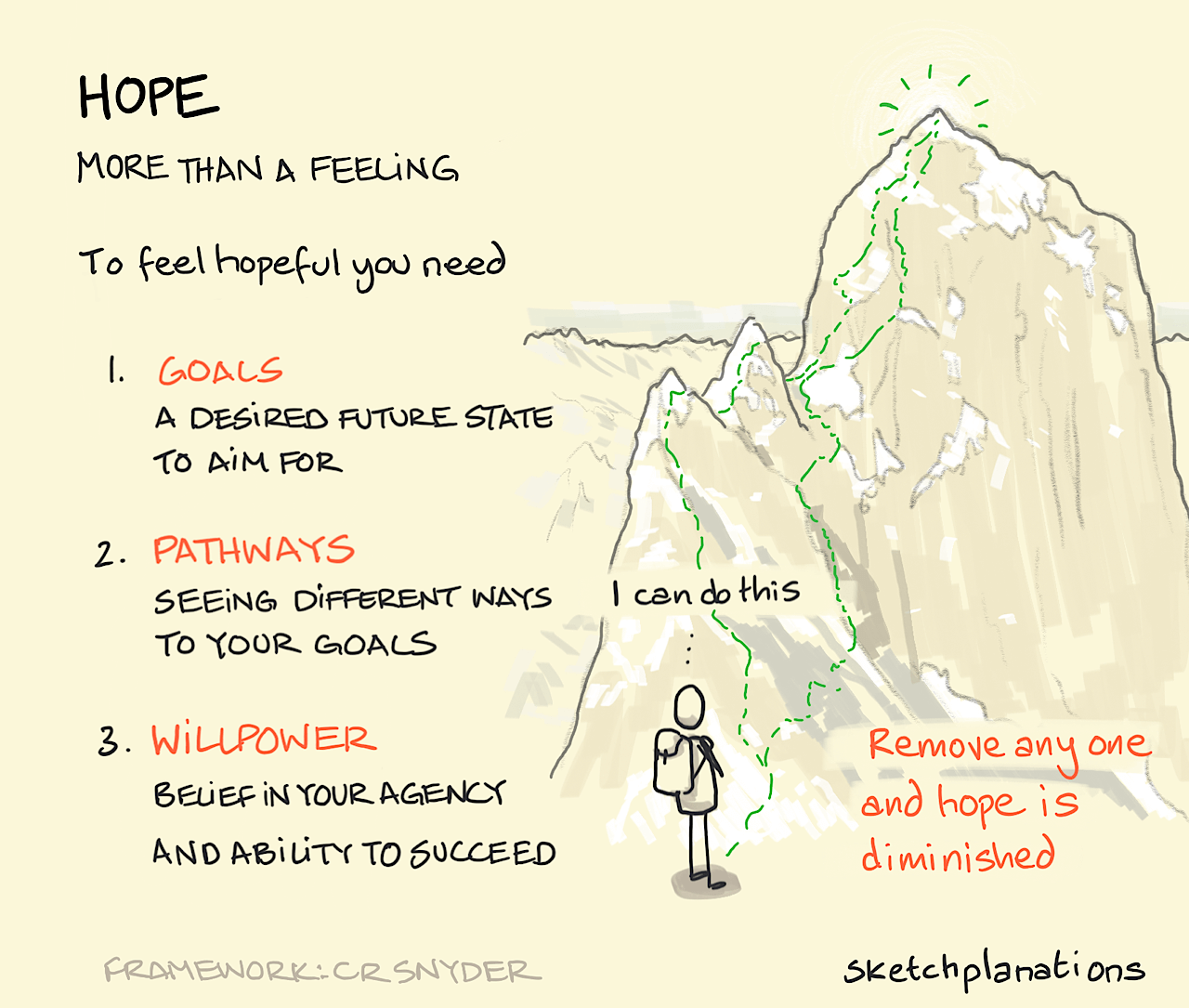
Credit to the wonderful sketchplantions for this image - link to website right here
There are several benefits of a hopeful mindset, such as:
Greater psychological well-being and enhanced well-being over time
It is protective against the development of chronic anxiety
It produces motivation to initiate and sustain action, plus is motivates an individual to maintain positive involvement.
A word about hope and optimism, as they have much in common, but it's an overlapping Venn diagram, not a match. For the optimist, you expect life to work out as expected. The hopeful recognise that it might not work as expected, but that there will be a positive outcome working towards the goal. At this point, I want to dive into the Stockdale paradox - but more on that next week.
There can be barriers to hope, and these can be good to name and to work through. Firstly, a lack of control. When there is the inability to effect the changes you desire in your life/work/team, that can lead to hopelessness. When control is removed, how can we expect people to hang onto hope? When people's ability to influence or have a say is removed, why and how can they remain hopeful?
For hope to be maintained, a support structure is critical. The isolation that can occur feeds hopelessness and a lack of motivation. With a solid support structure, positive possibilities are easier to imagine. Storytelling and sharing those feelings is such a powerful way to connect people who think they are in it alone.
When I sat down to write about hope, I listed a number of examples where I have noticed and felt hopeful and where I've shared a little hope with others. These came so freely and easily to mind it was a powerful example of how reflection, journaling, and sharing stories can build resilience and hope. Here they are for you now.
When describing an upcoming challenge to the team and truly believing myself when I said I know this will be hard, and I know together we can do this.
In a walking meeting and discussing numerous challenges and issues I use the phrase 'I don't know what the answer is, but I do know the answer is out there and that I'm determined we'll get there'.
When I walk along a corridor with a new colleague, and we share bits about ourselves and form a new connection
When I listen to a young nurse talk to the chief nurse about the work they have been doing (yes, I felt old too, but hope quickly overwhelmed, and I had a huge smile on my face)
When I got the feedback that, by the way, I lead I inspire people to want to do the hard things
When a conversation sparks up with strangers in a socially distance mask wearing coffee queue about socks (silly sock Friday), and I share the Pink Socks Story.
When I sit with my team at the end of a long week, and we all feel tired, we laugh and joke and look forward to the next week. We share how we'll balance the load and give each other time off. We have each other’s backs, and we care. We have hope.